Making a first-of-its-kind decentralized network trustworthy, usable, and operable all the way to revenue
SpaceRouter is an extension-program product where you can use or provide a decentralized network, with providers earning rewards for it. Because one landing page had to explain itself to three audiences with different goals, I designed it to self-select early, routing each type straight to the detail that mattered to them. As UX/UI lead, I built the landing page and the product's design system to give this decentralized network a coherent flow, information architecture, and trustworthy UX.
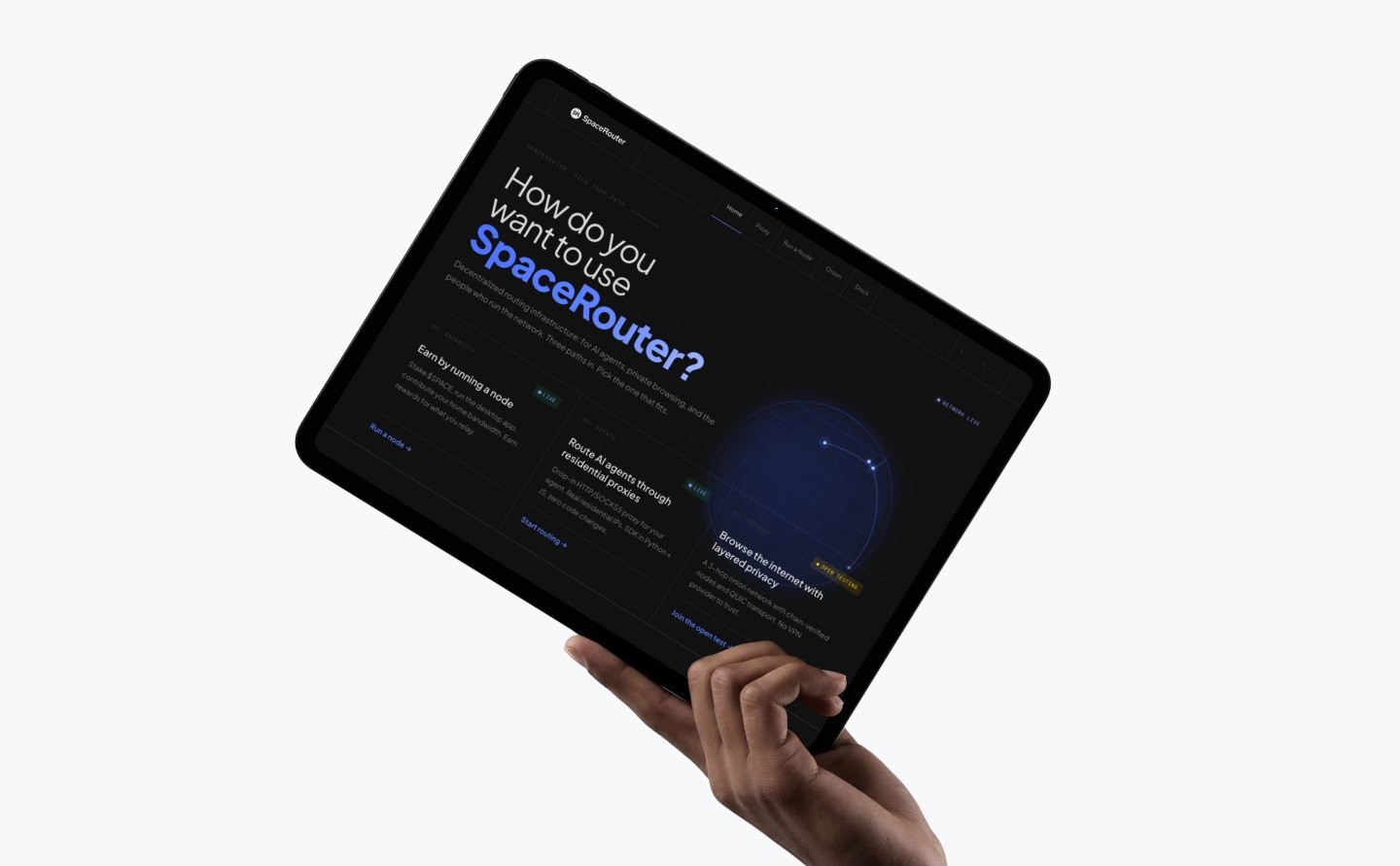
The self-select homepage, live: three doors, three audiences, one screen.
Problem
Three products running on one decentralized network, each solving a different problem for a different person, and each one invisible unless you already knew the jargon: what a "node" is, why browsing needs three hops, how an AI agent gets past a block in the first place. Most people never got far enough to find out.
Solution
Self-selection up front, so each visitor lands on the one product built for them, plus a trust model that shows how the network actually works instead of asking people to take it on faith.
Practice
Talked to all three audiences and watched where they actually stalled, not just what they said. The same confusion surfaced every time: three unanswered questions the site had to resolve before anyone would commit.
Role
- UX strategy, IA and user research
- End-to-end prototyping and UI design
- Design system, narrative and art direction
Tools
- Figma, design and system source of truth
Process
- Research
- The Insight
- The System
- Where This Scales
- Impact & Retrospect
1.
Research
Watching where three very different audiences actually stalled, not just asking what they wanted.
1.1 Three Products, No Shared Vocabulary
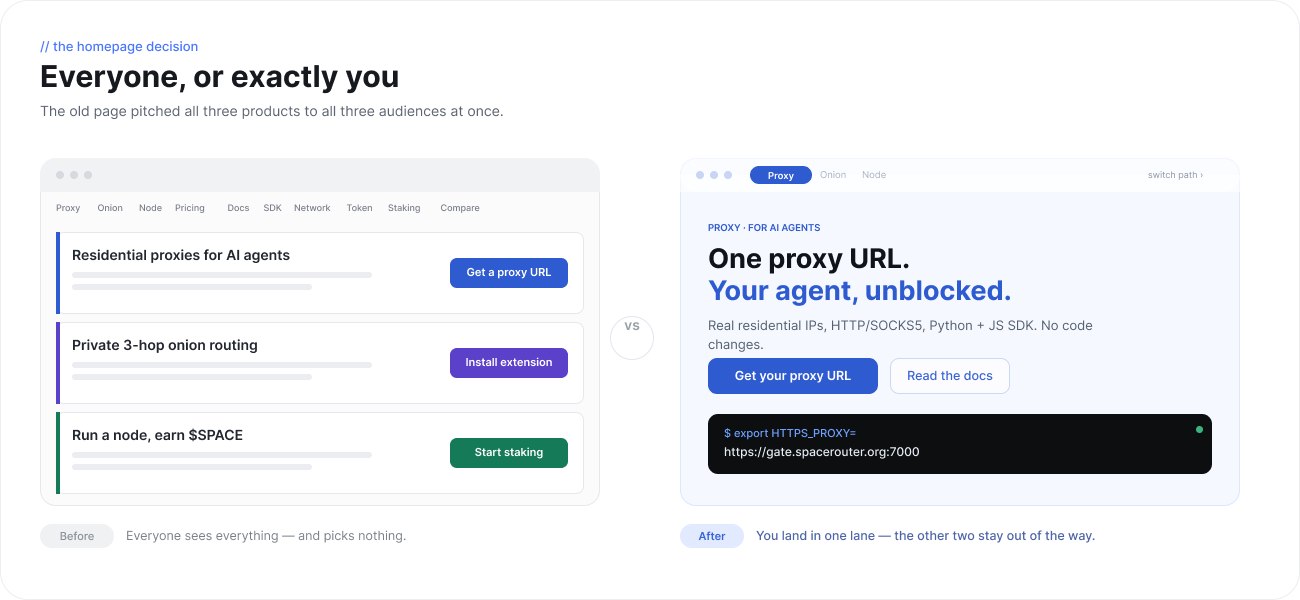
Agent access, private browsing, and node hosting are three genuinely different jobs running on the same decentralized network, and the old site explained all three at once, to everyone, in the same breath. Everyone saw everything, and picked nothing: an agent developer had to wade through staking copy to find an API, a privacy seeker had to skim past token economics to find the browser extension.
1.2 How the Research Ran
We talked to all three audiences and watched where they stalled. The same confusion surfaced every time: three questions the site had to answer before anyone would commit.
The three questions nobody could answer
- "Which path is mine, earn, build, or browse?"
- "Proxy or Onion? They sound the same, when do I use each?"
- "Why trust a decentralized network with my traffic?"
Key findings
- An agent developer, a privacy seeker, and a node operator share one network but not one vocabulary.
- Proxy and Onion were the most confused pairing on the site: similar names, opposite jobs.
- Trust couldn't be asserted for a decentralized, no-brand-name network; it had to be shown, hop by hop.
2.
The Insight
One network has to convince three people who want opposite things, and who trust nothing by default
The insight that shaped everything: an agent developer, a privacy seeker, and a node operator share one network but not one vocabulary. Force them through a single funnel and everyone bounces. So we led with self-selection: three clear doors, then split the products by job. Proxy gets an agent past bot detection; Onion lets a person browse without leaking who they are.
The site had to do more than describe a stack: it had to route people. So we built a path-based IA mapped to intent: a three-door entry to self-select, a side-by-side that separates Proxy from Onion, a security layer that earns trust, then the bigger picture tying SpaceRouter to the wider network. A card system lets it scale as new products ship.
3.
The System
A live decentralized network, the trust model that makes it usable, and the site that routes people into it.
3.1 The Network, For Real
Before anything about pages or audiences, there's a network that has to actually work: pick a circuit strategy, and the app builds a route through real relay nodes, not an abstraction on a marketing page.
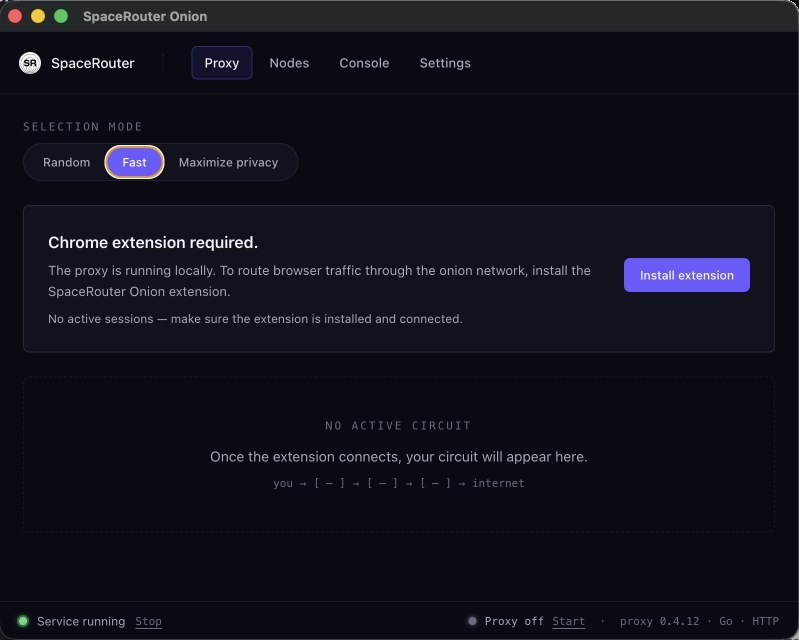
Pick a circuit strategy, connect the extension, watch the hops fill in as the connection builds.
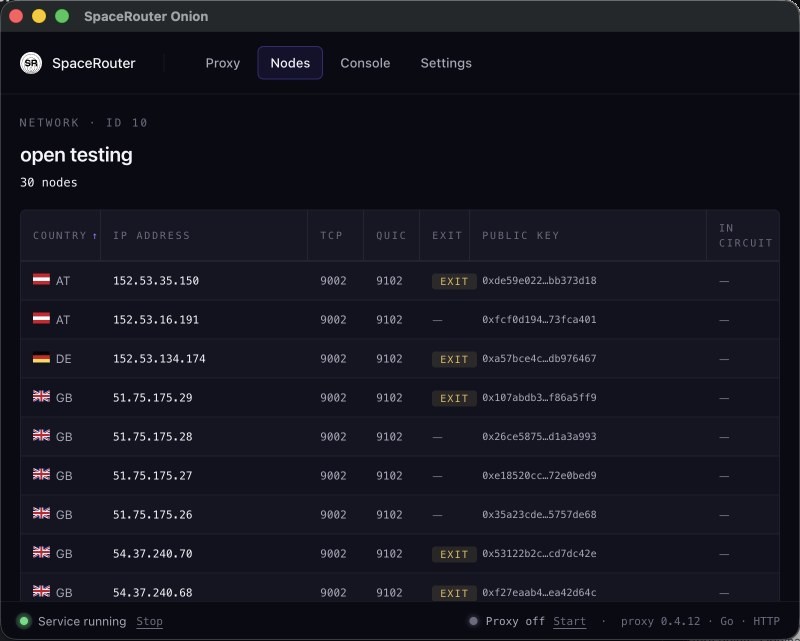
The relay network itself, not a diagram of one: real nodes, real countries, exit nodes flagged.
3.2 What Proxy, Onion, and Node Actually Do
Three products, one network, three different jobs. Before the redesign the names alone did all the explaining; a visitor had to already know what a "node" was to guess what it did. Now the site leads with the job each product does, so nobody has to guess which one solves their problem.
Most networks and services block AI agents outright: automated traffic gets flagged before it ever finishes a task. Proxy routes that traffic through a real residential home network instead of a data center, so a request looks like it's coming from an actual home connection rather than a server farm.
Onion solves a different problem: it decentralizes the route itself, splitting it into layers so no single point, not even a node in the chain, can see both who you are and where you're going. That's what makes it untrackable rather than just private.
Node is the supply side underneath both of them: run the app, share your home connection, and Proxy or Onion traffic can route through it. In return you're rewarded in $SPACE. Proxy and Onion are what a visitor comes for; Node is what makes either one possible.
All three start the same way: install the SpaceRouter Chrome extension. Once it's on your device, you're set up to route an agent, browse privately, or host a node, from the same install.
3.3 Making Trust Legible
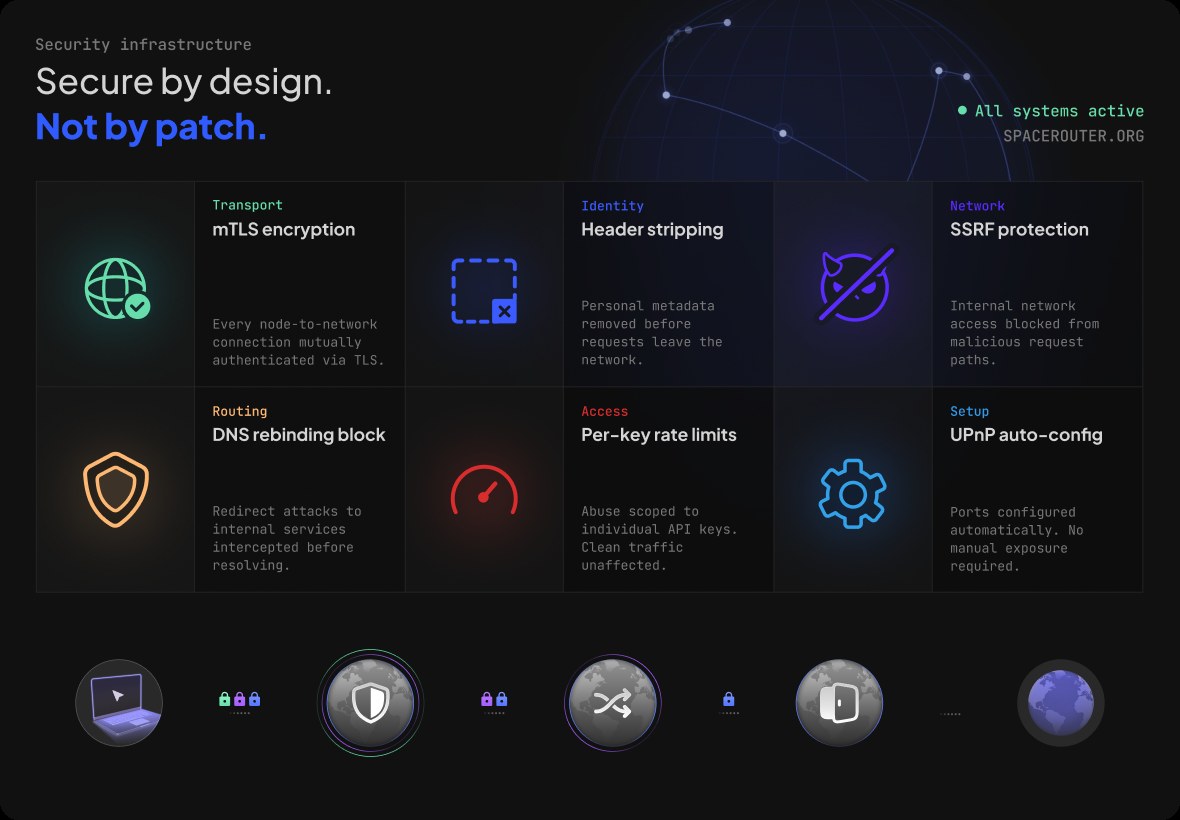
The hardest thing to make legible was the onion path. People had to trust a 3-hop network without understanding cryptography, and without a brand-name VPN to fall back on. The design had to show, not claim: who can see what at each hop, and why no single node ever knows both who you are and where you're going.
Drawing on how people actually reason about privacy, we drew the three hops as a chain: Guard, Middle, Exit, each labeled with exactly what it can and can't see. Chain-verified nodes replace "just trust us," turning an abstract guarantee into something a newcomer follows at a glance.
3.4 One Funnel for Everyone, or One Path Each
We replaced a single catch-all funnel with a self-select that splits into three short, focused routes.
BeforeOne page tried to convince three audiences at once, most left before finding their part.
AfterEach visitor self-selects once, then follows a short route built only for them.
What we set out to improve
Stop making people read three pitches to find their one. Ask a single question up front, what are you here to do, then show only the route that answers it.
What we expect
Far fewer early exits, a clear split of who picks which lane, and each audience reaching its goal (URL, extension, or first stake) in fewer steps.
3.5 The Front Door: How the Site Routes People In
Once someone understands what the network actually does, the site's only job is to get them to the right door fast. The old page pitched all three products to all three audiences at once; now each visitor picks a lane in the first screen, and the rest of the site speaks only their language. I ran a short round of internal testing to compare how easily each of the three audiences reached their door, building simple prototypes in Claude to test the layout.
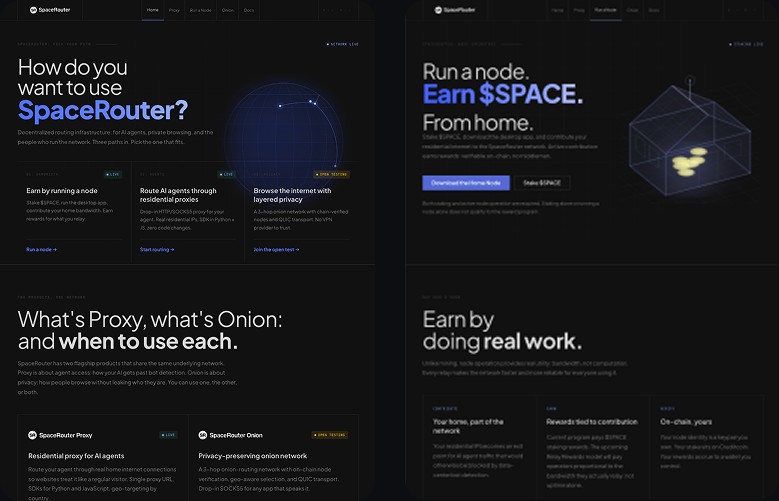
The self-select entry and the Node lane, live: the front door, not the network itself.
4.
Where This Scales Roadmap, not shipped
The card-based IA wasn't built for three products. It was built for however many SpaceRouter ships next.
One shared SpaceRouter network, a coordination API, residential home nodes, $SPACE escrow, sits underneath Proxy and Onion today. The same stack is the foundation for what's next: Proxy, Onion, and eventually satellite internet, routed through the same coordination layer, out to orbit. The card system that lets a new product page ship without a redesign is what makes that roadmap credible rather than aspirational.
5.
Impact & Retrospect
Where each path stands, reported honestly, lane by lane.
Three audiences, one network. They want opposite things: agents want raw access, browsers want to disappear, operators want to get paid. The old site showed all three to everyone and let them sort it out. Now you pick your lane in the first screen, and the rest of the site speaks only your language. Here's where each lane actually stands today.
Proxy
For AI agents · Shipping (live)
Agent devs drop in one proxy URL and go, no code changes. This lane is doing its job. Now tightening the SDK quickstart so the first request lands even faster.
Onion
For private browsing · In testing (open beta)
The 3-hop story finally reads as clearly different from Proxy. The browser extension works; the desktop app stays private while we harden it. Close, not done.
Node
For operators · Early (staking live)
Operators can stake and run today. The real draw, getting paid for bandwidth, isn't live yet, so the rate is a placeholder and ISP rules still trip some people up.
The signal we're after: a visitor lands, picks a lane in seconds, and never sees the other two. One network that feels like three focused products.
What I learned
- Self-selection beats a smarter funnel. If your audiences want opposite things, let them say so in the first screen instead of writing better copy to serve all of them at once.
- Trust has to be shown, not claimed. The 3-hop chain diagram did more work than any amount of "we take your privacy seriously" copy ever could.
The goal was never a slicker homepage and product. It was to stop asking three people to sit through one pitch, and to let each of them find their own path in seconds, the first time.